WHAT IS PLANETARY HEALTH?

Air Pollution

Humanity’s impact on Earth’s natural systems is affecting the quality of the air we breathe.

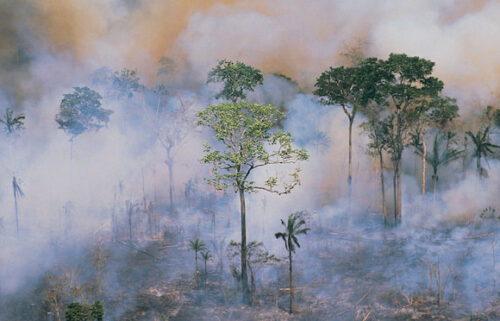
Air pollution is attributed to natural sources like dust storms, and human activities like vehicle emissions, industrial processes, burning wood, and power plants. Inhaled particulate matter (e.g., PM2.5) can penetrate deep into the lungs, causing respiratory issues, heart disease, and other health problems, especially for vulnerable populations. Biomass burning for agriculture in places like equatorial Asia is driving sharp increases in particulate air pollution and associated morbidity and mortality. In some regions, air pollution has become so pervasive that it obscures the sun, altering regional weather patterns, reducing agricultural yields, and accelerating glacial melting.  

In addition to particulate pollution, warmer temperatures associated with climate change increase the formation of tropospheric ozone, a main constituent of smog and contributor to cardiorespiratory disease. Warmer temperatures and higher atmospheric carbon dioxide concentrations are associated with longer pollen seasons and increased pollen production, intensifying allergic respiratory diseases, such as asthma. 

8M Deaths per year

One modelling study concluded that fine particulate and ozone air pollution contribute to more than 8 million all-cause deaths per year.

Air-pollution deaths are substantially more likely in low- and middle-income countries.

Browse the resources below to learn more about air quality and ways to protect the air we breathe.

 “… pollution control is highly cost-effective and, because pollution, climate change, and biodiversity loss are closely linked, actions taken to control pollution have a high potential to also mitigate the effects of those other planetary threats.”

– Lelieveld et al. Pollution and health: A progress update

Air Pollution Resources

Tip: Use quotation marks while searching for your term (e.g., "climate change") to find exact terms.

Close

Filter by:

Resource Type
Planetary Boundaries
Health Impacts
Sectors
Interventions
Perspectives
Regions
Year

253 Results

Not finding what you’re looking for?

Newest First

Filters

The impact of green spaces, urban settings, seasonal changes, and pollutants on dissemination of antimicrobial genes in air. Nature Scientific Reports.

Air Pollution Built Environment and Urbanization

The impact of green spaces, urban settings, seasonal changes, and pollutants on dissemination of antimicrobial genes in air. Nature Scientific Reports.

UHIs may be a reservoir of ARGs in urban air, hence, planting non-allergenic trees and bushes or hedgerows could be an effective way to decrease the dissemination of aerosolised ARGs.

• Research & Reports
Yuping, D., Cole, J., Mkrtchyan, H.V., et al.

Epigenetic alterations induced by air pollution: A key driver in atherosclerosis development. Cardiovascular Toxicology.

Noncommunicable Diseases Air Pollution

Epigenetic alterations induced by air pollution: A key driver in atherosclerosis development. Cardiovascular Toxicology.

This review article examines how long-term exposure to air pollution contributes to atherosclerosis through epigenetic changes like DNA methylation, histone modifications, and altered non-coding RNA expression. It highlights new pathways for cardiovascular disease prevention and treatment.

• Research & Reports

Goleij, P., Amin Khazeei Tabari, M., Majma Sanaye, P., et al.

Assessing air pollutant removal and carbon sequestration across urban forest stands and individual species in a medium-sized southern Italian city. Environmental Science and Pollution Research.
A small church with a pointed steeple sits in a lush green valley, surrounded by dense, dark green forest under towering, misty mountains.

Air Pollution Land Use and Land Cover Change

Assessing air pollutant removal and carbon sequestration across urban forest stands and individual species in a medium-sized southern Italian city. Environmental Science and Pollution Research.

Urban areas are characterized by elevated levels of air pollution and carbon emissions resulting from human activities. Given the potential of urban forests to mitigate both air pollution and carbon emissions, this study focused on quantifying these ecosystem services in Monte Sant’Antonio’s urban forest, located in Campobasso, Italy.

• Research & Reports

Antenucci, E., Russo, A., Marchetti, M., and Gargi, V.

Air pollution and atherosclerosis. Atherosclerosis.

Noncommunicable Diseases Air Pollution

Air pollution and atherosclerosis. Atherosclerosis.

This review provides an overview of how air pollution promotes the development of atherosclerosis (the build up of fats and cholesterol in and on the artery walls).

• Research & Reports

Seneviratne, A.N. and Miller, M.R.

Environmental modulators of vascular physiology and inflammation. Experimental Physiology.

Noncommunicable Diseases Air Pollution

Environmental modulators of vascular physiology and inflammation. Experimental Physiology.

The review examines how environmental factors, particularly pollutants and natural compounds, influence vascular physiology, inflammation, and the development of atherosclerosis (the build up of fats and cholesterol in artery walls) and cardiovascular disease.

• Research & Reports

Seneviratne, A.N., Majumdar, A., Surendranath, K., et al.


News Related to Air Pollution

See More