BUILDING MOMENTUM

Planetary Health Alliance 2025 Mid-Year Report

Capturing six months of remarkable growth during our 10th Anniversary year—from 500+ member organizations worldwide to our new UNDP partnership and record PHAM participation. This report is just a preview of the Alliance’s growing capacity to catalyze the systemic changes necessary for a thriving planet and flourishing communities everywhere.

Photo by Nastya Kvokka

Summary


The Planetary Health Alliance is now connected across 80+ countries with a mobilized community of 500+ member organizations, each amplifying Planetary Health principles within their own spheres of influence. The numbers in this report tell a story of a global movement gaining momentum at precisely the moment when humanity’s relationship with Earth demands transformation.

Through strategic partnerships with the United Nations Development Programme, leading academic centers, and nongovernmental organizations worldwide, PHA has positioned Planetary Health at the intersection of research, policy, practice, and hope. Our educational initiatives now reach schools around the world, while our 10th Anniversary campaign has sparked storytelling from organizations eager to share their vision for the next decade.

Photo by National Institute of Allergy and Infectious Diseases

Through systematic educational integration, strategic policy partnerships, and community mobilization, we’re building a future in which life on Earth advances together. The organizations in our network are agents of transformation within their communities, disciplines, and regions. Their adoption of Planetary Health principles creates ripple effects extending far beyond our direct reach.

Our 10th Anniversary campaign is stimulating reflection on achievements while focusing energy on the challenges ahead. All of the dimensions of health demand awareness and action, research and implementation, individual behavior change and systems transformation. We are an alliance that is ready to continue building community, advancing excellence, influencing policy, and innovating in communications – across every sector of society – to safeguard human health on a rapidly changing planet.

  • Discover achievements and action in each of the tabs below.

Photo by Martin Sanchez

The next decade will determine whether humanity is successful in navigating immense planetary challenges threatening our health and well-being, and that of all life on Earth. PHA’s role is to ensure that when future generations look back on this period, they will see 2025 as the year when the Planetary Health movement gained the foothold and momentum necessary to transform our relationship with Earth.

Each achievement in this report represents real people making tangible differences in their communities. Each partnership creates new pathways for Planetary Health principles to reach those who need them most. Each publication shifts academic discourse toward greater recognition of the interconnections between human health and the Earth system. In sum, our collective achievements are the changes so acutely needed.

  • Discover achievements and action in each of the tabs below.

Educational Leadership & Academic Impact


LEARN MORE

Advancing Planetary Health in Global Education
  • Our systematic approach to medical education transformation launched with targeted outreach to 200+ medical schools across North America, as a pilot program
    • PHA launched a survey to gather insights from educators, students, and professionals in the medical field about the top priorities for integrating Planetary Health into undergraduate medical education across North America. The idea is to use the survey as a movement-building tool. By participating, faculty members, academic staff, medical students, and/or medical professionals affiliated with, teaching at, or studying at a medical school in the United States or Canada will help shape actionable recommendations.
  • The Planetary Health Education Action Plan Working Group, convened by PHA to take the next ambitious and actionable steps in Educating for the Great Transition, as laid out in the Planetary Health Roadmap, has been working on four well-defined projects:
    • Creating Planetary Health Curriculum Guidance that aligns with the Roadmap’s call to transform education. This document will complement the Planetary Health Education Framework, with an expectation that its core threads are always aligned.
    • Creating video storytelling materials that showcase diverse perspectives on global environmental crises and highlight the interconnectedness of Planetary Health challenges. Organized into three storylines—Personal Experiences, Awakenings, and Planetary Health Success Stories. These stories can open the door to more constructive conversations, even in polarized settings.
    • Developing a Policy Toolkit that serves as a practical resource for educators on how to write effective policy briefs that can influence policymakers and drive environmental change.
    • Engaging educators through the “Let’s Teach Planetary Health” webinar, which aims to mainstream Planetary Health frameworks in educational settings around the world. This webinar is intended to be inclusive, accessible, and welcoming to educators across disciplines and geographies.
  • PHA continues to provide implementation support through practical resources for curriculum integration at institutional and departmental levels
Course Inventory Expansion
  • Community submission: A new website feature better enables global community contributions

Presentations & Thought Leadership


February 

March  

  • PHA joined the Medical Society Consortium on Climate and Health and several other health organizations in planning the  Our Planet Our Health: 2025 Climate Action Summit in Washington DC. 
    • The Plenary Session “Plastics and Health” explored the health impacts of plastic pollutionfrom microplastic exposure to toxic chemical risks, and the environmental consequences across the plastic life cycle. Speakers reviewed evidence-based policies for plastic reduction, assessed innovative alternatives, and shared strategies for healthcare professionals and institutions to lead efforts in reducing plastic use and driving systemic change. The session was led and moderated by Tulsi Modi. 
    • Tulsi Modi also led the Parallel Session “Empowering Future Leaders: Youth Contributions to Climate and Health. This session explored the vital role of youth-led initiatives in addressing the intersection of climate change and health. Participants examined the health impacts of climate change, evaluated outcomes of youth-driven actions, and gained insights into strategies for fostering meaningful youth engagement in policy and action at all levels. 
    • Carlos Faerron was a panelist in the session “Critical Research Needs in Climate, Health, and Planetary Health,” examining how interdisciplinary research can inform policy solutions to address the Earth Crisis and its health impacts. 
  • Carlos Faerron was an invited lecturer at the Children’s Hospital of LA at the University of Southern California, where he delivered a lecture on Planetary Health to Global Health IMPACT Track residents. 
  • Carlos Faerron delivered a guest lecture on “Global Health and Complexity” at the Universidade Federal de Ciências da Saúde de Porto Alegre, as part of their Global Health Course. 

April 

  • Jelena Malogajski, PHA’s Education Director, joined the panel “Incorporating Planetary Health into Medical Education – Tools, Lessons, and Community Building” at the International Congress on Academic Medicine (ICAM) in Halifax, Canada. This panel brought together experts from around the world to discuss advocacy efforts and the integration of Planetary Health principles into medical education and research.  
  • Jelena Malogajski and Hannah Turley, PHA’s Partnerships Coordinator, were panelists at the session “Advancing Global Health: Bridging the Planetary Health Roadmap and the World Health Summit Agenda” at the World Health Summit Regional Meeting in New Delhi, India. 
  • Carlos Faerron delivered a lecture as part of the Texas Tech University Health Sciences Center Office of Global Health Lecture Series, titled “Health in the Anthropocene.”

May 

  • Sam Myers, PHA’s founding director, delivered a keynote address at the inaugural Planetary Health Symposium, hosted by Brown University’s Division of Biology and Medicine. This event marked a significant moment in the university’s commitment to the growing field of Planetary Health. Notably, the Division of Biology and Medicine has integrated Planetary Health into its mission statement. 
  • Sam Myers delivered the ST Lee Lecture at Washington University, titled “Planetary Health: Safeguarding Health on a Rapidly Changing Planet,” to a cross-university audience of faculty, staff, and students. Attendees included the head of the new Center for the Environment, faculty from the recently established School of Public Health, and members of the McDonnell International Scholars Academy. 
  • Marie Studer, PHA’s executive director, participated in a panel fully led by Next Generation organizers, “The Nexus between Planetary Health, Climate and Environmental Crises, and Youth Mental Health,” a side event for the United Nations’ 10th Multi-stakeholder Forum on Science, Technology, and Innovation for the Sustainable Development Goals (STI Forum). 
  • Carlos Faerron participated in a seminar and panel at Universidad Autónoma de Chile, Cátedra UNESCO: “Salud Planetaria: ¿Qué estamos haciendo para adaptarnos a las olas de calor?”
  • Jessica Kronstadt spoke at two side sessions of the 78th World Health Assembly, including a World Federation of Public Health Associations’ workshop on Decolonizing Public Health and “Climate Change and Health: Adaptation and Resilience in a Changing World,” organized by the Geneva Health Forum and Tsinghua University. 
  • PHA co-hosted the launch of The Sunway Charter: Faith in Action, and Sam Myers spoke at the launch event. 
  • Two PHA fellows, Emmanuel Benyeogor and Tatiana Camargo, participated in a webinar from BMJ Leader entitled “People, Planet, Leadership – Global Collaborations,” as part of community-building around their Planetary Health Leadership topic collection. 

June 

July 

Profile


Samuel S Myers: Planetary health champion. The Lancet.

Planetary Health Frameworks

• News

Samuel S Myers: Planetary health champion. The Lancet.

Samuel S Myers, the Director of the Planetary Health Alliance and the Johns Hopkins Institute for Planetary Health, has a message for health professionals.

Publications & Research Contributions


News Release


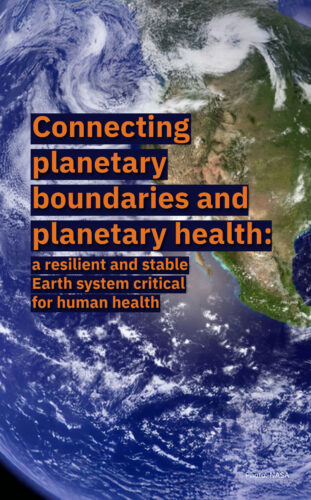
The first systematic collaboration between Planetary Boundaries and Planetary Health research communities, with Sam Myers serving as joint first author on this landmark Lancet Comment that establishes four cornerstones for integrating Earth system science with human health policy. This publication represents leadership in advancing the field’s maturation from concept to actionable framework, demonstrating capacity to synthesize diverse scientific expertise into influential outputs that shape global health and environmental policy discourse.

In Development

Planetary Health Glossary

Led by Chris Graham, Digital Education Manager at the Royal College of Physicians of Edinburgh (RCPE), a PHA Member Organization. This community-developed glossary is a Healthcare Leadership Academy Scholar project, bringing together diverse contributors with relevant expertise to create standardized terminology and definitions for the field. The developed glossary will facilitate consistent communication while making complex concepts accessible to newcomers.

Medical Subject Headings

“Planetary Health” has been submitted for inclusion as a MeSH (Medical Subject Heading) term in the next MeSH update (November 2025). Overseen by the U.S. National Library of Medicine, MeSH is the controlled vocabulary used to index journals in PubMed. Inclusion of “Planetary Health” would represent a significant step forward in connecting Planetary Health research, improving discovery by researchers, and encouraging new studies. A supporting bibliography tracing foundational works and consistent use of the term in literature over the past ten years is being developed by Andrea Copland, PHA’s Library Technician.

Another Major Publication

More information will be released soon about comprehensive coverage of Planetary Health for environmental science and engineering audiences.