How do the Sustainable Development Goals Connect to Planetary Health?
Planetary Health Campus Ambassador Amy Fernando explores the often underdefined relationship between the Planetary Health Framework and the Sustainable Development Goals, highlighting the need for coordinated, collective action to advance both in parallel toward a more sustainable future.
In the landmark report that defined Planetary Health as a field, Whitmee et al. referred to the SDGs as a “great opportunity to integrate health and sustainability.”
The Connection
Planetary Health was formally established as a field in November 2015,2 a few months after United Nations member states adopted the Sustainable Development Goals (SDGs).3 Since then, reference to these goals has become a notable element of Planetary Health discourse.4,5 Both Planetary Health and the SDGs were created to meet contemporary social and environmental needs. However, despite their intuitive parallels, the relationship between these concepts remains largely undefined.
The Frameworks
Planetary Health is a “solutions-oriented transdisciplinary field and social movement focused on analyzing and addressing the impacts of human disruptions to Earth’s natural systems on human health and all life on Earth.”6 The SDGs are 17 interconnected goals outlining international objectives related to health, equality, economic growth, and environmental protection, among other priorities.7 Both concepts acknowledge interconnected systems and consider the wellbeing of future generations in the context of environmental change.
“I think we’re all looking at the same concern. We want to have a future in which everyone has the opportunity to thrive. We can’t get there if we continue to destroy our life support system, which is the Planet Earth.”
– Jessica Kronstadt (Planetary Health Alliance)
Given their similarities, several authors have proposed integrating these frameworks through synergistic objectives that advance both Planetary Health and the SDGs. For example, Whitmee et al. promoted SDG indicators selected for their relevance to “human wellbeing, the enabling infrastructure for development, and the supporting natural systems.”8 Yet potential trade-offs remain. SDG 8 (Decent Work and Economic Growth), for instance, may at times conflict with environmental or health-related goals.
“If we’re trying on the one hand to push for a development agenda that revolves around economic growth, then that can work against health, wellbeing and equity. This is causing some interesting reimagining of the ‘growth imperative’ and challenging the saying that ‘more is always better.”
– Dr. Erica Di Ruggiero (University of Toronto & SDGs@UofT)
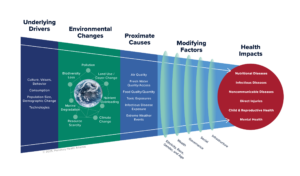
Nevertheless, many argue that the two frameworks are synergistic, as the SDGs address ecological determinants of health and other upstream drivers of health impacts emphasized in the Planetary Health framework (Figure 1). A recent review noted that several studies position the SDGs as determinants of Planetary Health within sustainable development contexts.9 Although only one SDG directly targets health and well-being (SDG 3), many others address factors associated with Planetary Health, including freshwater quality and access (SDG 6) and climate change (SDG 13).
Figure 1. Planetary Health Alliance. The Planetary Health Model. Source: Planetary Health Alliance, “Understanding Planetary Health Pathways,” last modified in 2025.
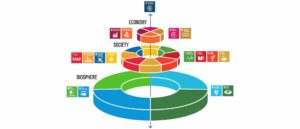
Beyond this, a growing number of studies have proposed new frameworks or approaches to formally explain the intersection between Planetary Health and the SDGs.11 The Wedding Cake Model (Figure 2), for example, links biophysical, societal, and economic “layers”12 in an organizational framework that broadly corresponds with the environmental changes, proximate causes, and modifying factors in the Planetary Health Model.
Figure 2. SDG Wedding Cake Model. Azote for Stockholm Resilience Centre, Stockholm University CC BY-ND 3.0.
An idea that often emerges in these frameworks is the adoption of a Planetary Health lens to link the SDGs, as they are often treated individually rather than as interconnected goals. “The SDGs end up perpetuating silos. When societies need to make choices of the 17, they’re probably going to have to prioritize goals,” said Dr. Di Ruggiero.
Nevertheless, from the outset, Planetary Health scholars have argued for its potential to connect the SDGs.14 As Kronstadt says, “Planetary Health helps to provide a framework to pull all the SDGs together. If you look at the individual SDGs, you see many of the things that we would consider those ecological determinants of health. You also see some of the societal efforts that really have a huge impact in terms how those ecological determinants of health are translated into human health and wellbeing.” This perspective can help mediate perceived tensions, such as those arising from the antagonism between economic growth and environmental protection agendas, by providing an overarching barometer for judging an intervention’s success.
Why it Matters
In the last decade, both the SDGs and Planetary Health have informed various policies and interventions. However, global progress towards the ultimate aim of producing a sustainably healthy population is unclear. The lack of connectivity between approaches like Planetary Health and the SDGs may be a factor impeding this target.15 From that perspective, these efforts, which all essentially share the same goals, must begin to work collectively to achieve them.
As Kronstadt put it, “There’s too much work to be done for these different efforts that all have essentially the same goal to not be working in parallel.”
More Information
About the Author
Originally from Winnipeg, Manitoba (Treaty 1 Territory), Amy Fernando is currently a graduate student at the University of Toronto studying air pollution. She is interested in examining and documenting how environmental changes alter population health. She previously served as Campus Ambassador for the Planetary Health Alliance.
References
[1,8,14] Whitmee, Sarah, Andy Haines, Chris Beyrer, et al. “Safeguarding Human Health in the Anthropocene Epoch: Report of the Rockefeller Foundation–Lancet Commission on Planetary Health.” The Lancet 386, no. 10007 (2015): 1973–2028. https://doi.org/10.1016/S0140-6736(15)60901-1.
[3,7] United Nations. “The 17 Goals.” Sustainable Development Goals. Accessed December 15, 2025. https://sdgs.un.org/goals.
[4,9,11] Pham, Long Tam, Pankaj Kumar, Wirawan Dony Dahana, and Hong Duc Nguyen. “Advancing Sustainable Development through Planetary Health—A Holistic Approach to Global Health: A Systematic Review.” Environmental Science & Policy 155 (May 2024): 103709. https://doi.org/10.1016/j.envsci.2024.103709.
[5] Pongsiri, Montira J., Sam Bickersteth, Cristina Colón, et al. “Planetary Health: From Concept to Decisive Action.” The Lancet Planetary Health 3, no. 10 (2019): e402–e404. https://doi.org/10.1016/S2542-5196(19)30190-1.




 Originally from Winnipeg, Manitoba (Treaty 1 Territory), Amy Fernando is currently a graduate student at the University of Toronto studying air pollution. She is interested in examining and documenting how environmental changes alter population health. She previously served as Campus Ambassador for the Planetary Health Alliance.