


News

Essay
Iraq’s Fraying Food Systems Warn of a Planetary Health Crisis
In Iraq, food system disruption is no longer a distant forecast. It is visible in diminished wheat fields under harsher skies, in smaller sheep flocks, in higher prices for meat and dairy, and in the uneasy coexistence of farms with oil infrastructure. The Planetary Health lens reminds us that truly nourishing food is never only about calories or markets, it is also about the wellbeing of the land, water, air, animals, and people who sustain one another.
Wheat farming in Salah al-Din Governorate. A visual reminder that staple production in Iraq remains labor-intensive and increasingly exposed to water stress and climate uncertainty. Photo by Abdullah Shihab.
A Food System Under Pressure
Across Iraq, the food system is being squeezed from several directions at once. Water scarcity, recurrent drought, degraded soils, conflict legacies, and uneven public investment have weakened the country’s agricultural base. Recent analyses of Iraq’s water-energy-food nexus show that food production cannot be understood separately from water governance, energy policy, and environmental stress (Yousif et al., 2023). Over the last two decades alone, water scarcity has already reduced cultivation, narrowed farmers’ choices, and increased pressure on food security (Sissakian et al., 2023). Satellite-based drought assessment confirms that vegetation stress, previously a temporary anomaly, has now become a recurring national pattern (Hatem et al., 2024).
Iraq’s agricultural history has long been shaped by a diverse mix of crops, livestock, and locally grounded farming knowledge. Yet over time, wheat has become the strategic center of agricultural production at both local and national levels. Wheat is economically and culturally essential, and bread security matters. But a food system becomes more fragile when it is concentrated on a single staple. As maize, sesame, vegetables, fodder crops, and mixed farming receive less attention, agricultural diversity declines, and so does nutritional resilience (Jongerden et al., 2019).
In Iraq, food insecurity does not begin at the market stall; it begins where rivers thin, soils tire, and flares burn beside fields.
When Water Leaves, So Does Security
When water sources become uncertain, every part of the food chain changes: Farmers reduce planting, pastures thin, feed becomes more expensive, and animals become harder to keep. Rearing a smaller flock does not only mean less meat in the market; it also means less milk at home, less manure for soil fertility, less stockpiling for emergencies, and less stability for rural ways of life (Sissakian et al., 2023; Hatem et al., 2024; Jongerden et al., 2019).
In Iraq, sheep and cattle are part of household nutrition, household economy, and cultural identity. When farming and herding stop being viable, the pressure to leave the countryside grows. The result is a quieter but deeply damaging transition: fewer producers, weaker local markets, and more dependence on purchased and imported foods. That burden is ultimately carried by ordinary households through higher food costs, less dietary variety, and greater financial insecurity. For this reason, the decline in livestock should not be treated as a side story, but as a core food-systems issue that exposes how water scarcity, shrinking pasture, and rural disruption are steadily undermining food security and system stability.
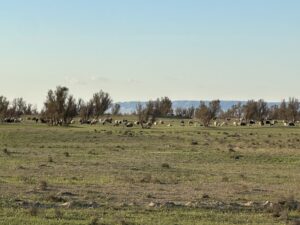
A smaller flock is not only fewer animals. It is less milk, less income, less resilience, and less life in the countryside.
Pollution Is Part of the Food Story
Iraq’s food-system struggle is not only a story of water scarcity and climate change, but also one of environmental pollution and its effects on land, water, livelihoods, and health. In some landscapes, farms and grazing lands sit beside oil fields, refineries, and gas flares. Studies from Basra have documented elevated gaseous pollutants in ambient air, while more recent work around the Al-Rumaila oil field shows that gas flaring continues to degrade local air quality (Douabul et al., 2013; Khreebsh & Azeez, 2024). For communities living and farming near these sites, pollution is not an abstract environmental concept; it settles on the same horizon as crops, animals, and homes.
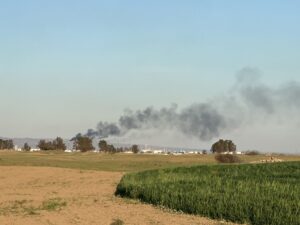
The reality of environmental pollution for these farmers demonstrates a foundational acknowledgement of Planetary Health: there is no true boundary between environment and human health. Polluted air does not stop at the fence of an oil facility. It enters lungs, workplaces, schools, and food landscapes (Whitmee et al., 2015). When a farmer breathes polluted air or when animals graze in degraded surroundings, the impact of that pollution extends from damaged ecosystems to the livelihood of those who tend the land, and the health of everyone it touches.
A flare burning beside a farm is not just an energy issue. It is a food-system issue, a public-health issue, and a Planetary-Health issue.
A Planetary Health Agenda for Iraq
A response to Iraq’s food crisis that acknowledges Planetary Health must therefore be broader than ‘produce more wheat.’ We should protect staple crops, yes, but we must also rebuild environmental diversity and resilience. That means investing in efficient irrigation, restoring soil, supporting fodder and forage systems, protecting small livestock keepers, reducing flaring and industrial pollution, and treating rural livelihoods as part of national health protection, not merely agricultural policy (Yousif et al., 2023; Sissakian et al., 2023; Hatem et al., 2024; Jongerden et al., 2019; Douabul et al., 2013; Khreebsh & Azeez, 2024).
It also means reframing food security itself. Food security is not secure when it depends on exhausted rivers, polluted air, and a shrinking base of rural producers. Truly healthy food systems are those that nourish people while protecting the ecosystems that make nourishment possible (Willett et al., 2019). For Iraq, that includes valuing local milk, meat, grains, vegetables, and traditional ecological knowledge, not only maximizing short-term output from one crop.
The images from Salah al-Din tell this story clearly: a wheat field still being worked, a flare burning beside farmland, and a sheep keeper still holding on. These images do not depict separate scenes but together show a food system under pressure. Iraq’s warning to the world is simple: a country cannot build lasting food security on ecological decline. Iraq’s opportunity is just as clear: if food policy begins with Planetary Health, then protecting rivers, farms, animals, and rural communities becomes an investment in public health, dignity, and national stability.
A country cannot build lasting food security on exhausted water, polluted air, and an emptied countryside.
More Information
About the Author
 Abdullah Shihab is a Planetary Health Alliance (PHA) Fellow and the 2026 Next Gen Steering Committee Representative. He is a final-year PhD candidate in Community and Environmental Health Nursing at the University of Baghdad, Iraq. His work examines climate change impacts on vulnerable populations by mapping how adaptation practices shape health and identifying practical, health-centered strategies that strengthen resilience. He has over five years of experience teaching and mentoring undergraduate nursing students, alongside delivering keynote talks on climate change and planetary health in national and international forums. Through this role, he works to strengthen collaborations that translate evidence into community-level action.
References
Douabul, A. A. Z., Al-Maarofi, S. S., Al-Saad, H. T., & Al-Hassen, S. (2013). Gaseous pollutants in Basra City, Iraq. Air, Soil and Water Research, 6, 15–21. http://dx.doi.org/10.4137/ASWR.S10835
Hatem, I., Alwan, I. A., Ziboon, A. R. T., & Kuriqi, A. (2024). Assessment of agricultural drought in Iraq employing Landsat and MODIS imagery. Open Engineering, 14(1), 20220583. https://doi.org/10.1515/eng-2022-0583
Jongerden, J., Wolters, W., Dijkxhoorn, Y., Gür, F., & Öztürk, M. (2019). The politics of agricultural development in Iraq and the Kurdistan Region in Iraq (KRI). Sustainability, 11(21), 5874. https://doi.org/10.3390/su11215874
Khreebsh, H. T., & Azeez, N. M. (2024). Assessment of gas flaring on air quality in the Al-Rumaila oil field region in Basra Governorate, Iraq. EnvironmentAsia, 17(3), 105–115. https://doi.org/10.14456/ea.2024.39
Sissakian, V. K., Al-Ansari, N., Adamo, N., & Laue, J. (2023). The impact of water scarcity on food security in Iraq. Journal of Civil Engineering and Architecture, 17(9), 441–456. https://doi.org/10.17265/1934-7359/2023.09.003
Whitmee, S., Haines, A., Beyrer, C., Boltz, F., Capon, A. G., de Souza Dias, B. F., Ezeh, A., Frumkin, H., Gong, P., Head, P., Horton, R., Mace, G. M., Marten, R., Myers, S. S., Nishtar, S., Osofsky, S. A., Pattanayak, S. K., Pongsiri, M. J., Romanelli, C., … Yach, D. (2015). Safeguarding human health in the Anthropocene epoch: Report of The Rockefeller Foundation-Lancet Commission on planetary health. The Lancet, 386(10007), 1973–2028. https://doi.org/10.1016/S0140-6736(15)60901-1
Related Resources

Planetary Health Frameworks
• Books
Foundations of Evaluation for Planetary Health

Planetary Health Frameworks
• News
Education to Improve the Planet’s Health, and Our Own. Psychology Today.

Planetary Health Frameworks
• Videos
Planetary Health Roundtable
