Community Spotlight
São Paulo’s “Food Detectives” are Investigating Equity & Access in Their Neighborhoods
Students at the Planetary Health Club at the University of São Paulo founded “Food Detectives,” a project to help young learners understand food systems in their neighborhoods.

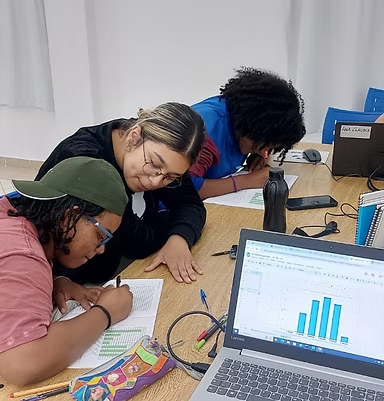
Data analysis in a partner organization; Source: Food detectives archive, 2024.

Food detectives hosting the municipal food security council meeting in a public secondary school; Source: Food detectives archive, 2024.

Food detectives hosting the municipal food security council meeting in a public secondary school; Source: Food detectives archive, 2024.

Territory mapping in a partner organization; Source: Food detectives archive, 2024.
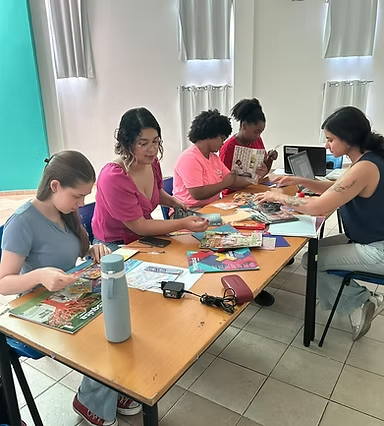
Introductory session with youth citizen scientists.

São Paulo’s municipal house of deputies discussing council’s results on the 2nd Sao Paulo’s food security panel, including food detectives results; Source: Food detectives archive, 2024.
Human health depends on the health of Earth’s natural systems. Our food systems sit at the center of this relationship: driving climate change and biodiversity loss while still failing to address global malnutrition and food insecurity.
To decode the complex links between our plates and the planet’s resiliency, the Brazilian Club for Planetary Health launched the “Food Detectives” project in 2021 at the Institute of Advanced Studies of the University of São Paulo (IEA-USP).
Food Detectives aims to democratize the scientific process, translating dense academic concepts into accessible and actionable language. The project integrates transdisciplinary expertise from students in biology, nutrition, agronomy, and communication to bridge the gap between academic “ivory towers” and local realities. Under the leadership of researchers like Profa. Dra. Aline Martins de Carvalho and Beatriz Sinelli Laham, the initiative seeks to transform the act of eating into a conscious, systemic understanding of food production.
Schools as “Living Laboratories”
The project targets youth aged 11-14, a critical period for identity formation and the development of critical thinking skills. Through a 44-page student booklet and a specialized guide for educators, Food Detectives utilizes a Didactic Sequence grounded in Citizen Science to engage students hands-on learning.
This investigative model turns schools into “living laboratories,” where students progress through four stages: orientation, data exploration, theory-based interpretation, and communication of findings. Acting as researchers in their own communities, these young “detectives” conduct practical investigations such as:
- Analyzing food labels to identify the prevalence of ultra-processed foods
- Tracing food origins to examine the carbon footprint of globalized supply chains
- Mapping local food deserts to understand barriers to healthy food access in their neighborhoods
Partnership with Municipal Leadership
A major milestone for the project was its strategic partnership with the Municipal Council for Food and Nutritional Security of São Paulo (COMUSAN-SP). This collaboration enabled students to move beyond classroom theory and engage directly in active citizenship.
The partnership came to life when council members visited municipal schools to hear research findings directly from 9th-grade students participated in an official Council plenary meeting, presenting their local data on food insecurity to municipal authorities
During these exchanges, students compared their neighborhood investigations with citywide data from the I Municipal Food Security Survey (ISA-Capital). Their research added a human dimension to municipal statistics, showing how broader trends reflect the lived reality of families in vulnerable areas – particularly in São Paulo’s Zona Leste.
Science as a Tool for Human Rights
When students generate evidence about their lived realities, science becomes a powerful tool for resistance and the defense of fundamental rights. By documenting local food insecurity, these young researchers provide concrete evidence that can inform more effective public policies, transforming information into a shield for the Human Right to Adequate Food.
“Food Detectives” is more than a book; it is a movement for social justice and Planetary Health. By connecting the classroom to the communities, educational spaces become essential actors in global health, fostering a generation of “guardians of biodiversity”.
The project aims to scale its methodology to other regions of the Global South using a decolonial lens, ensuring that Planetary Health is not just an academic concept but a lived practice of dignity and citizenship.
The project materials are available as open-source resources on the Portal de Livros Abertos da USP for educators and citizens worldwide.