From Crisis Response to Anticipatory Resilience: A Planetary Health Approach to Disaster Management in South Asia
PHCA Seemab Mehmood argues that recurring floods in South and Southeast Asia reveal deep health system vulnerabilities and the limits of reactive disaster response. She calls for a Planetary Health approach that integrates climate science, public health, and regional cooperation to build anticipatory resilience and long-term well-being.
Village in Punjab, Pakistan. Photo by Arshad Jamil.
The stakes could not be higher. The climate is changing faster than our systems are adapting. But with Planetary Health–informed strategies, South and Southeast Asia can build a future where environmental stewardship and human well-being advance together.
Seemab Mehmood
As a young healthcare leader and Planetary Health advocate, I am compelled to confront the recurring human suffering, loss of life, and profound economic damage caused by repeated disasters, particularly in low- and middle-income countries, where recovery remains disproportionately difficult for both affected populations and governments.
Climate-related disasters are transcending national borders, putting millions at risk in a region where health systems are already under strain. According to UNICEF, more than 6.67 million people have been badly affected by devastating floods in Pakistan, with over 1.9 million evacuated from their homes (UNICEF, 2025). Across the nation, more than 946 lives have been lost, including 320 children, making this the most severe flooding since the catastrophic monsoon season of 2022 (Associated Press, 2025).
The disaster does not stop at Pakistan’s borders. In northern India, at least 37 people have died since early August, and heavy rains have destroyed crops across tens of thousands of hectares, threatening food security and rural livelihoods (Reuters, 2025).
A Region Trapped in a Cycle of Climate Disasters
While the 2025 floods are among the deadliest in recent memory, they are not isolated events. Pakistan has faced five major flood emergencies in the past 15 years, with 2010 and 2022 being particularly devastating:
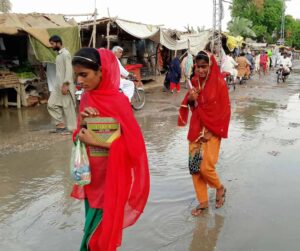
Women passing through a road overflowing with water in Naundero, Pakistan. Photo by Jamal Dawoodpoto.
2010 “Super Floods”: Impacted 20 million people, submerged one-fifth of the country, and caused damages exceeding $10 billion (World Bank, 2010).
2022 Monsoon Floods: Affected 33 million people — nearly one in seven Pakistanis — with 8 million displaced and 1,700 lives lost. Damages and economic losses reached $30 billion (World Bank, 2023).
2025 Crisis: While smaller in scale than 2022, the current floods are concentrated in Punjab and Sindh, two densely populated regions that play a vital role in agriculture and the national food supply.
Climate scientists warn that South and Southeast Asia’s river basins are becoming “disaster hotspots” (Shrestha et al., 2021). Warming ocean temperatures, glacial melt in the Himalayas, and more erratic monsoon rainfall are fueling more frequent and intense flooding. Urbanization without climate-sensitive planning, such as building on floodplains and inadequate drainage in cities magnifies the impact.
Flooding is not just an environmental event; it is a health emergency. The Pakistan floods of 2025 have exposed several persistent weaknesses:
Lack of surveillance and early warning systems: More than 3,900 villages were inundated with little advance warning. Effective flood forecasting models exist but are underfunded and poorly integrated with community alert systems.
Insufficient medical resources and infrastructure: Floodwaters heighten the risk of cholera, malaria, dengue, and respiratory infections. Many rural health centers lack power, clean water, or basic medicines. Mobile medical teams were deployed late and in limited numbers, leaving entire communities stranded without care.
Fragmented disaster response: Coordination among government agencies, NGOs, and local responders has been inconsistent. While local NGOs provided boats and emergency supplies, the absence of a unified command system delayed evacuation and relief. Slow rehabilitation efforts heighten the likelihood of secondary health crises after floodwaters recede.
These systemic weaknesses are not unique to Pakistan. Health systems across South and Southeast Asia, including Myanmar, Bangladesh, Vietnam, and the Philippines, face similar vulnerabilities. Despite challenges, several promising interventions offer lessons for the region:
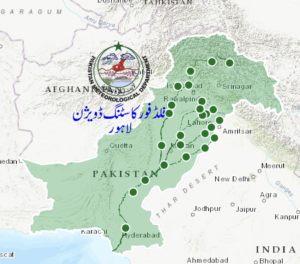
Pakistan’s Flood Forecasting Division (FFD): Established under the Pakistan Meteorological Department, the FFD has developed real-time river monitoring and rainfall forecasting. However, it lacks resources and community integration. Scaling and funding such models could dramatically improve early evacuation and local preparedness.
Bangladesh’s Cyclone Preparedness Programme: Though cyclone-focused, this community-led warning and evacuation model shows how early alerts combined with trained local volunteers can save lives. Similar systems could be adapted for floods.
Health resilience programs in the Philippines: After Typhoon Haiyan, the Philippines invested in climate-resilient health infrastructure, such as elevated, solar-powered clinics and prepositioned medical supply hubs. These initiatives demonstrate how climate-proofing health facilities can sustain care during disasters.
Regional climate-health partnerships: Platforms such as the Asia Pacific Observatory on Health Systems and Policies are beginning to map climate vulnerabilities. Expanding their mandate to operationalize Planetary Health principles could strengthen regional resilience.
Why is a Planetary Health Lens Valuable for South and Southeast Asia?
Planetary Health — the recognition that human well-being depends on the health of the planet — offers a strategic framework to move beyond crisis response toward prevention and preparedness. Unlike siloed approaches, Planetary Health integrates:
Multidisciplinary expertise: Combining climate science, public health, engineering, and disaster management to guide planning.
Geography- and climate-sensitive policies: Designing infrastructure and health systems tailored to local environmental risks.
Collaborative networks: Linking governments, academia, NGOs, and local communities for real-time monitoring and coordinated response.
For South and Southeast Asia, this is not abstract theory. The region shares monsoon-driven hydrology, densely populated floodplains, and climate-sensitive agriculture. A Planetary Health approach can transform disaster management from reactive relief to strategic, anticipatory resilience. By learning from Pakistan’s experience, South and Southeast Asia has an opportunity to:
Invest in climate-resilient health systems that can function even when roads are submerged.
Make Planetary Health a central policy lens, connecting climate adaptation, urban planning, and public health.
Shift from reacting to disasters to anticipating and reducing their impact.
Disclaimer: This essay was produced with the assistance of AI technology, which was employed to enhance the writing and translation process.
More Information
About the Author
Seemab Mehmood, a medical student at Fatima Jinnah Medical University. She has been serving as IFMSA Pakistan President consisting of 60+ Local Chapters and more than 4000+ members nationwide. She had been an CUGH Trainee Advisory Commitee Chair for the year 2024-25. And with her great interest in Global Health, she is aspiring to advocate for Planetary Health in her communities in Pakistan. She strongly believe that one of the sustainable solution for 21st century challenges lies in Planetary and Digital Health Interventions towards classical healthcare model we are practising.
Climate-sensitive health counselling for planetary health: Adapting a conceptual framework to local healthcare conditions in Accra, Ghana. GAIA – Ecological Perspectives for Science and Society.
Hildebrandt, J., Perez Arredondo, A.M., Kistemann, T., et al.
Disaster Preparedness and AdaptationGovernance and Policy
•
Research & Reports
Bridging the gap between climate and health systems: The value of resilience in facing extreme weather events. International Journal of Environmental Research and Public Health.



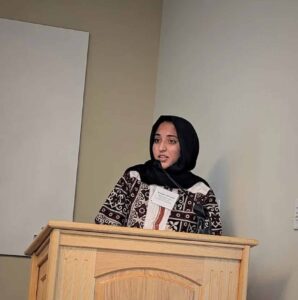 Seemab Mehmood, a medical student at Fatima Jinnah Medical University. She has been serving as IFMSA Pakistan President consisting of 60+ Local Chapters and more than 4000+ members nationwide. She had been an CUGH Trainee Advisory Commitee Chair for the year 2024-25. And with her great interest in Global Health, she is aspiring to advocate for Planetary Health in her communities in Pakistan. She strongly believe that one of the sustainable solution for 21st century challenges lies in Planetary and Digital Health Interventions towards classical healthcare model we are practising.