Essay
When Rivers Remember: Ecocide, Environmental Memory, and Planetary Health in Postwar El Salvador
This piece argues that El Salvador’s Civil War-era ecocide and its lasting ecological damage are inseparable from the country’s human trauma, showing how environmental restoration and historical justice must move forward together as a form of Planetary Health.


Standing at the River
A river can carry many histories. It can sustain everyday life, provide food and water, mark a route of escape, or become the site of profound violence. In El Salvador, rivers, forests, and mountains continue to bear witness to the Civil War (1980-1992), holding traces of a conflict whose consequences did not disappear with the signing of the 1992 Peace Accords.
Through Surviving Memory in Postwar El Salvador, a community-based research project hosted by Western University and funded by the Social Sciences and Humanities Research Council of Canada, we work with survivors and younger generations to document memories of the war and support their work toward historical memory, justice, and healing. Understanding the Civil War’s legacy—in both human memory and natural landscapes—requires combining archival records, oral histories, and community knowledge of the land. Together, these forms of evidence remind us that wars do not end when the fighting stops: their effects continue to shape both people and the environment. Perhaps nowhere is this interconnected violence—and the resilience that confronts it—more visible than along El Salvador’s rivers.
Ecocide and the Environmental Costs of War
We cannot even begin to comprehend the trauma that comes from conflicts like the Salvadoran Civil War without expanding our definition of violence to include ecocide, the large-scale destruction of ecosystems, that in this case results from military strategies and counterinsurgency campaigns (Martin, 2024). Under the military’s tierra arrasada (scorched-earth) campaigns, the natural environment was viewed as an enemy meant to be destroyed. In 1984 and 1985 alone, the Salvadoran military reportedly dropped 2,829,000 pounds of bombs across the country (Faber, 1993). This onslaught used napalm capable of incinerating areas the size of 1.5 football fields in seconds, white phosphorus rockets that ignited spontaneous forest fires, and antipersonnel bombs that shaved the forest floor. On the ground, troops systematically slaughtered livestock, burned crops, and contaminated water sources to render entire regions uninhabitable (Weinberg, 1997).
This violent destruction of nature is why we must look through the lens of Planetary Health, a framework that recognizes human wellbeing as structurally inseparable from the health of the earth, to bring lasting transitional justice. When an ecosystem is destroyed, the violence ripples across communities for generations. Today, this ecocidal legacy persists in eroded hillsides, disrupted watersheds, and toxic topsoil, showing that a community cannot truly heal if the land and water that sustain it remain wounded.
Yet, damaged landscapes also become places where memories of the war continue to be lived, shared, and passed across generations. French Historian Pierre Nora developed the concept of landscape as a site of memory, or “liex de memoire,” to describe this phenomenon: a place where the past is recalled, shared, and given meaning (Nora, 1989). While such sites are often associated with monuments, museums, or archives, in rural El Salvador memory is also embedded in rivers, forests, and agricultural landscapes marked by histories of displacement, violence, survival, and return. These landscapes remain connected to collective memory through everyday relationships with the land as well as commemorative practices, particularly at sites of wartime violence such as the Sumpul River, where a massacre occurred in 1980, and the Lempa River, where another took place in 1981.
Water as a Living Archive
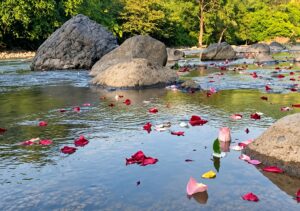
On May 14, 1980, Salvadoran soldiers and paramilitary forces attacked civilians gathered near Las Aradas, in the department of Chalatenango. As families tried to cross the Río Sumpul into Honduras, Honduran troops blocked their escape. At least 300 people—including children and older adults—were killed. Each year, survivors, relatives, and younger generations return to the river to honour the victims, share their memories, and demand justice. For survivors such as Felipe Tobar, the changes to the river are particularly visible. Recalling the river of his youth, Felipe remembered that “fish were abundant” and “the water was beautiful,” in contrast to what survivors see each year when they return to commemorate the massacre. Looking at the quantity of water, Felipe fears that “water will no longer flow through the Sumpul.” When we asked Felipe about the ties between historical memory and environmental protection, he had no doubt: “they are connected.”
Less than a year later, on March 17, 1981, Salvadoran forces attacked communities in the department of Cabañas, forcing thousands of civilians toward the Río Lempa. As they attempted to cross into Honduras, at least 200 people were killed or drowned. One survivor, Rosa Lainez, recalled being eighteen years old and carrying her one-year-old child as the community fled toward Honduras. Unable to swim, she eventually entered the swollen Lempa holding her child against her chest and clinging to a makeshift floating structure until she reached the other side.
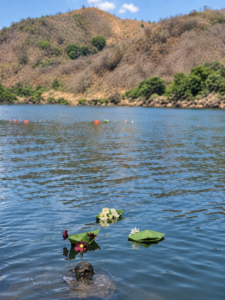
Over the last forty-four years, community members return annually to the river to commemorate the Lempa River Massacre. They read victims’ names aloud, sing songs recounting the displacement, and place flowers in the water for those who died there or were carried away by its current. For Rosa, returning to the river alongside younger generations also brings hope: the Lempa is not simply a site of wartime violence, but a living landscape through which histories continue to be transmitted.
Yet, the Lempa tells a story that extends beyond the war. When speaking with Rosa and other survivors, their memories showed that the waters are deeply embedded in the history of the communities living beside them and remain an integral part of everyday life.
As El Salvador’s largest watershed, the Lempa has sustained agriculture and rural livelihoods for generations. Today, it also bears the combined pressures of hydroelectric development, industrial agriculture, mining, pollution, and climate change. Contemporary efforts to defend the river therefore build on a much longer history of ecological violence and community resistance. Water is not simply a natural resource; it carries stories, songs, memories of displacement, and practices of care that continue to shape how communities understand and respond to today’s environmental challenges.
From Environmental Memory to Planetary Health
For Indigenous communities globally, history, ancestry, and collective identity are rooted in the landscape they call home. Rather than existing purely as an exploitable resource, rivers and forests serve as living archives of shared heritage. Consequently, when war, resource extraction, or settler colonialism deliberately ravage these vital ecosystems, the collective memory stored within them is fractured as well. Therefore, achieving true Planetary Health in a post-conflict society means recognizing that restoring an ecosystem is deeply intertwined with restoring its people’s history and their right to remember.
This intersection of memory and ecological restoration is evident on the slopes of Volcán Guazapa in the San Salvador Department. During the Civil War, Guazapa was a major stronghold of resistance, subjected to continuous and devastating aerial bombardments. Yet, in the face of this ecocidal legacy, a profound initiative for transitional justice took root. Working alongside local youth, the Salvadoran Center for Appropriate Technology (Amigos de la Tierra El Salvador or CESTA) – founded by Dr. Ricardo Navarro – established an ecological memorial.
The project sought to plant over 65,000 fruit-bearing and medicinal trees, a tree for every single individual who lost their life during the twelve-year conflict. The “Monsignor Óscar Arnulfo Romero Reconciliation Forest” honors those who lost their lives by bringing life back to a devastated landscape. The forest is named after St. Óscar Romero, the Archbishop of El Salvador at the time and an early prophetic voice for environmental justice. Romero advocated relentlessly for fair treatment of the country’s poor, often victims of state violence, and denounced the monopolies of water and fertile soil that marginalized rural campesinos (JPIC, 2024). Romero’s life and work reminds us with great clarity that the desecration of the earth and the slaughter of its people flow from the exact same systems of structural exploitation and inequality.
By understanding memory to include dynamic biological processes, the Forest of Reconciliation provides an expansive and transformative example of living transitional justice. As the trees mature, they suppress invasive grasses, revive the secondary forest, and provide a sanctuary to wildlife. The forest honors the memory of those who were killed while securing the Planetary Health of those who survived: environmental remediation itself becomes an act of historical accountability and social repair.
Closing Thoughts
The rivers and volcanoes of El Salvador remind us that the legacies of war are never only political or human—they are also ecological. Long after the violence ends, its effects continue to shape the landscapes that sustain everyday life and the memories of those who inhabit them. Ecological restoration must therefore become part of historical justice and community resilience. Protecting the Sumpul and Lempa means recognizing them not only as vital sources of water and life, but also as living archives of violence, survival, and care.
Sources
Faber, D. (1993). Environment Under Fire. Monthly Review Press.
JPIC. (2024). St. Oscar Romero and Integral Ecology.
Meszaro, H. (2024). Blind Spots in the Archive of Ecocidal War: Following archives of images, military documents, and governmental agencies reveals the role of herbicides in U.S.-backed counterinsurgency campaigns across Latin America and beyond. NACLA Report on the Americas, 56(2), 205–213. https://doi.org/10.1080/10714839.2024.2356316
Nora, P. (1989). Between Memory and History: Les Lieux de Mémoire. Representations, (26), 7–24. https://doi.org/10.2307/2928520
Weinberg, S. (1997). El Salvador Civil War: ICE Case. Mandela Project.
About the Authors

Dr. Giada Ferrucci is an interdisciplinary scholar whose research focuses on environmental justice, historical memory, and community archives, with a particular emphasis on Central America. In 2017 and 2018, she interned in El Salvador with Asociación para el Desarrollo de El Salvador [Association for the Development of El Salvador, CRIPDES], then joined the project “Surviving Memory in Postwar El Salvador.” Her work examines the intersections of environmental conflict, historical memory, displacement, and grassroots resistance, exploring how communities mobilize cultural and environmental resources to confront socio-environmental injustices. She is especially interested in environmental memory and communication, extractivist industries, and participatory approaches to knowledge production.
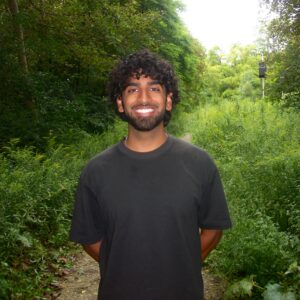 Amaan Thawer is an MSc candidate in Global Health at McMaster University and holds an undergraduate degree in Geology from Western University. He serves alongside Yvonne Mongare as Co-Youth Director of the Planetary Health Alliance North American Regional Hub. Grounded in his experiences across India, El Salvador, and Indigenous communities on Turtle Island, Amaan works at the intersection of human rights and health equity to advocate for environments where all people can flourish.
About the Author